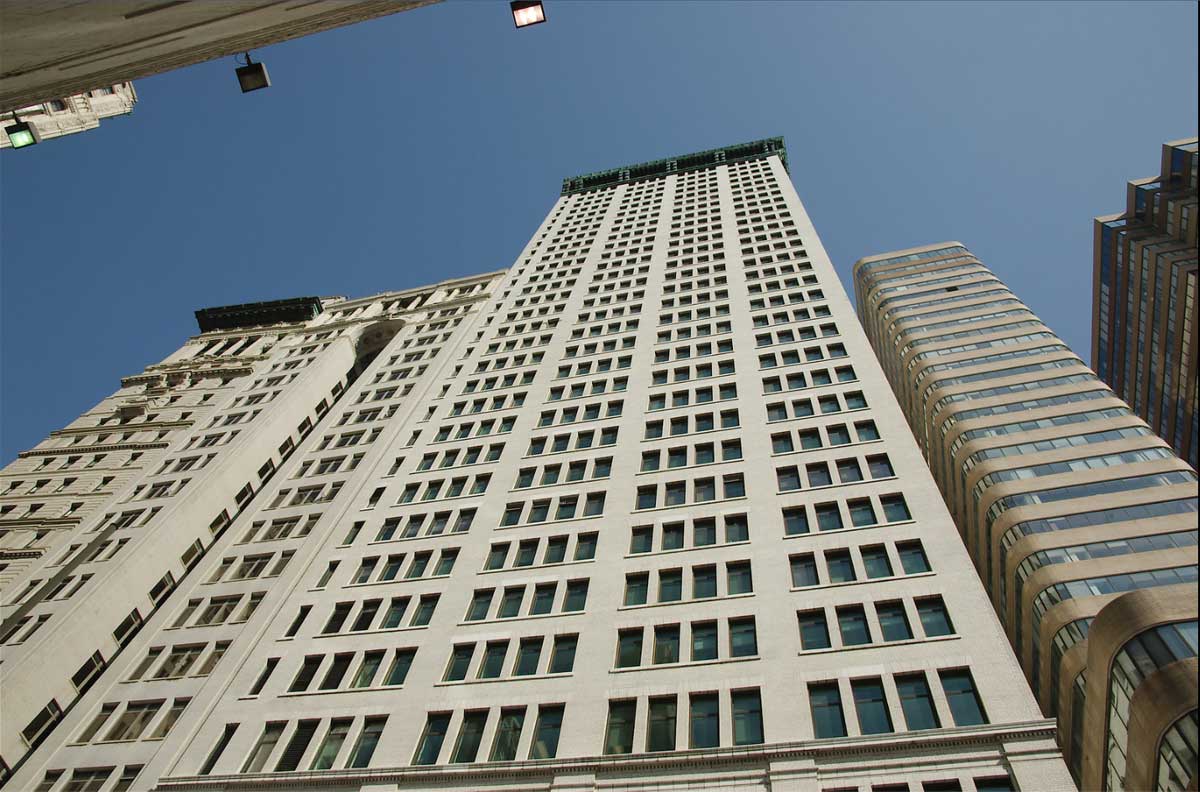
A major residential conversion is moving forward in Manhattan’s Financial District as developers prepare to transform the historic office tower at 61 Broadway into nearly 800 new apartments.
The redevelopment will convert the 33-story Adams Express Building, a century-old office property originally completed in 1913, into a 796-unit residential tower in one of the largest office-to-apartment projects currently underway in Lower Manhattan.
The project is being developed through a joint venture between RXR Realty and One Investment Management.
Once complete, the redevelopment will significantly expand the residential population of the Financial District while advancing New York City’s broader push to convert underutilized office buildings into housing.
Transforming a Century-Old Office Tower
The property at 61 Broadway, located near the New York Stock Exchange and Trinity Church, has long been a fixture of Lower Manhattan’s office market.
Originally designed by architect Francis H. Kimball, the building rises 33 stories and contains roughly 750,000 square feet of space.
Like many older office buildings in the Financial District, however, the tower struggled with vacancy in recent years as tenants shifted toward newer office space or adopted hybrid work arrangements.
At one point the building was reported to be more than half vacant, reflecting broader challenges facing older office properties across the city.
Developers ultimately determined that residential conversion offered the most viable path forward for the property.
A 796-Unit Residential Community
Plans call for the building to be redeveloped into 796 rental apartments, making it one of the larger housing conversions currently planned in Manhattan.
Approximately 25 percent of the units — roughly 200 apartments — will be designated as affordable housing, helping the project qualify for city incentive programs designed to encourage office conversions.
In addition to residential units, the redevelopment will introduce approximately 40,000 square feet of amenity space for residents.
Design work for the conversion is being led by architecture firm CetraRuddy, which specializes in large-scale adaptive reuse and residential design.
Financing a Half-Billion-Dollar Redevelopment
To move the project forward, the development team secured a financing package totaling roughly $475 million to $500 million, reflecting the scale and complexity of the conversion.
The capital stack includes:
- $420 million construction loan provided by affiliates of Apollo Global Management
- $55 million tax equity investment from JPMorgan Chase.
The financing package was arranged by a capital markets team at JLL.
Construction is expected to begin this year, with the first residential units projected to deliver in 2028.
Lower Manhattan’s Office Conversion Wave
The redevelopment of 61 Broadway is part of a rapidly growing wave of office-to-residential conversions reshaping Lower Manhattan.
Following the pandemic and the rise of remote work, older office buildings have struggled to compete with newer towers in Midtown and Hudson Yards. At the same time, New York City continues to face a severe housing shortage.
City and state policies have increasingly encouraged conversions as a way to address both challenges simultaneously.
Across Lower Manhattan, several large projects are now underway converting outdated office buildings into residential communities — including major redevelopments at 80 Pine Street, 40 Exchange Place, and other Financial District properties.
The trend has helped transform the neighborhood from a primarily daytime business district into one of the fastest-growing residential areas in New York City.
Final Thoughts
The redevelopment of 61 Broadway illustrates how developers are repositioning aging office buildings as housing in response to shifting real estate fundamentals.
With nearly 800 new apartments planned, the project represents one of the largest office-to-residential conversions currently underway in Manhattan.
For Lower Manhattan, the transformation continues a decades-long evolution that has steadily reshaped the Financial District into a mixed-use neighborhood where residential living plays an increasingly central role.
Subscribe to Real Observer
Stay ahead of the market. Real Observer covers New York Tri-state development, capital markets, and real estate intelligence every weekday. Subscribe free →