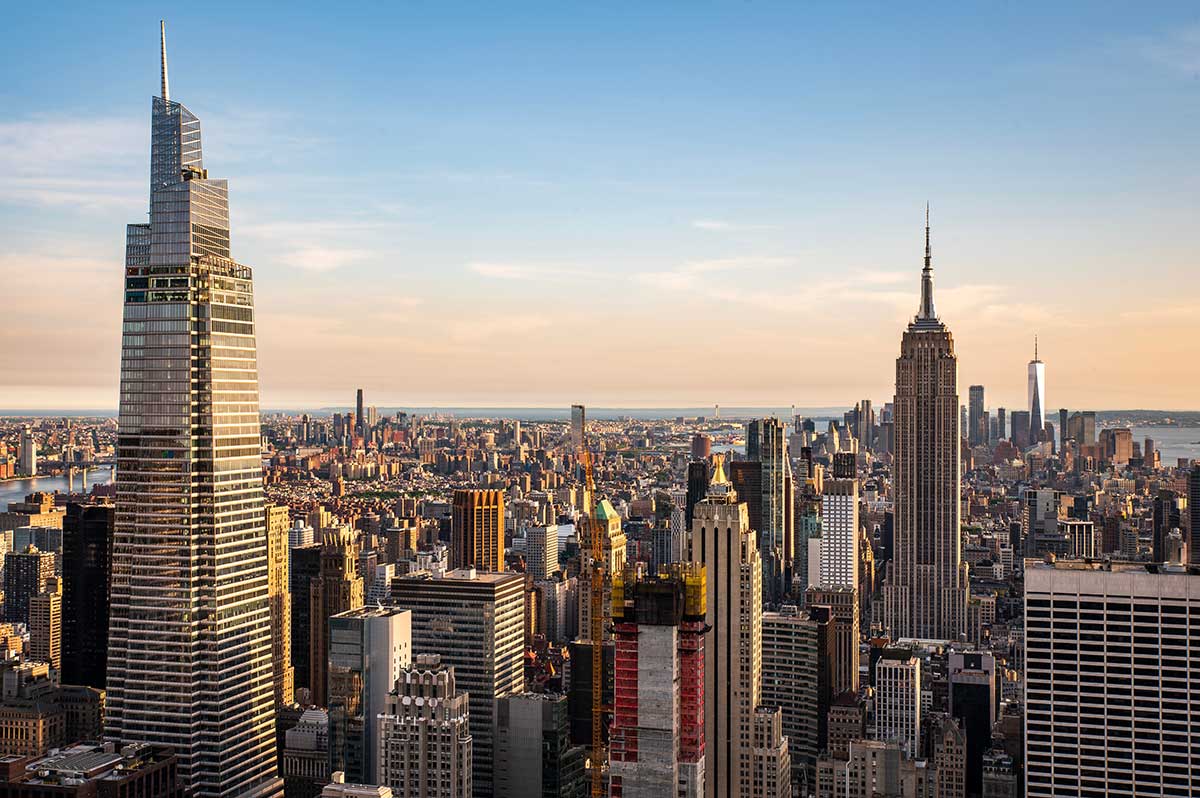
For the past two years, the phrase “K-shaped recovery” has been tossed around in CRE circles as a framework — a way to explain why some sectors were thriving while others bled out. As of March 2026, it’s no longer a framework. It’s the architecture of the entire market. Every major asset class, every capital structure, and every deal pipeline now runs on a single logic: the top arm climbs, the bottom arm gets pruned, and the gap between them widens by the quarter.
What follows is a sector-by-sector breakdown of where we are right now — backed by the deals, the data, and the buildings that tell the story.
Office: The Trophy Towers Are Full. Everything Else Is Getting Erased.
The Manhattan office market just posted numbers that would have been unthinkable three years ago. Companies signed roughly 43 million square feet of leases in 2025 — the most since 2014, and 20% more than the prior year. Manhattan’s availability rate dropped to 13.9% by year-end, down from 16.5% in December 2024. The sublease market? Roughly 7.3 million square feet of sublease space was pulled off the market last year, a nearly 40% reduction.
But the headline number obscures the real story: the split.
The Top Arm: Trophy Dominance
Trophy space availability in Midtown has now fallen to 3.4%, per Savills, with asking rents for those buildings up 12% year-over-year to $191 per square foot. Hudson Yards and the Plaza District command $160+ per square foot, with select deals clearing $200. The flight-to-quality phenomenon is no longer a trend — it’s a structural rewiring of how tenants make decisions.
The deals prove it:
- One Madison Avenue — SL Green secured a $1.7 billion refinancing just this week (March 19), converting construction-era debt into long-term financing. The tower is anchored by Franklin Templeton, Coinbase, Palo Alto Networks, and IBM. Its tower floors and retail are 100% leased. This is part of SL Green’s $7 billion capital-markets game plan for 2026.
- 590 Madison Avenue — RXR’s Gemini Office Venture closed on the nearly $1.1 billion acquisition last year — the first NYC office building to trade above a billion since Alphabet’s Hudson Square buy in 2022. The 42-story Plaza District tower, originally IBM’s headquarters, is now part of a $3.5+ billion portfolio that includes 1211 Avenue of the Americas and Starrett-Lehigh, all acquired at up to 50% discounts from peak valuations.
- 245 Park Avenue — SL Green signed nearly 500,000 square feet of new leases in the first two months of 2026 alone, including a 150,000 SF expansion by a global investment firm at this address.
- 11 Madison Avenue — A $1.4 billion, five-year refinancing was completed in September 2025 at a 5.625% fixed rate. The 2.3 million square foot tower is 93% occupied, with UBS, Sony, Pinterest, and Tempus AI on the tenant roster.
- 270 Park Avenue — JPMorgan’s new all-electric supertall HQ has effectively reset the definition of “Class A.” Buildings without net-zero certifications or integrated wellness amenities are being reclassified as Class B by default.
The message is consistent across every deal: if you’re a modern, amenity-rich, well-located tower, lenders are showing up with billion-dollar checks. If you’re not, you’re not getting a call back.
The Bottom Arm: The Great Pruning
The buildings that aren’t competing aren’t just struggling — they’re being systematically removed from the inventory.
- 222 Broadway — Former Goldman Sachs space, recently sold at roughly $195 per square foot. That’s a 71% discount from its 2014 price.
- 1740 Broadway — Traded at a 69% discount to prior valuations.
- Worldwide Plaza — Senior lenders filed a $940 million foreclosure suit against SL Green and RXR in late February 2026. The CMBS loan had been modified multiple times since 2025 and is split across several securitized deals. Extend-and-pretend didn’t work.
- One New York Plaza — Brookfield’s $835 million loan went into maturity default in January 2026, with no further extension options remaining.
The office CMBS delinquency rate hit a record 12.3% in January 2026 — surpassing the Financial Crisis peak by more than a full percentage point. Close to $25 billion in CMBS loans are now past maturity without repayment, liquidation, or formal extension. More than half of the estimated $100 billion in securitized commercial mortgages due this year are unlikely to pay off at maturity.
But here’s the thing: for the city’s housing goals, this collapse is the plan.
The Conversion Pipeline
New York is converting its office deadweight into apartments at unprecedented scale. Developers plan to begin construction on 9.5 million square feet of office-to-residential conversions in 2026 — more than double last year and nearly double the previous peak set in 2008. The 467-m tax incentive program, which provides up to 35 years of tax relief for projects incorporating affordable housing, has been the primary catalyst.
The active pipeline includes projects that would have been hard to imagine even two years ago:
- 25 Water Street — The largest office-to-residential conversion in U.S. history. The former JPMorgan/Daily News headquarters is becoming 1,300+ homes.
- 5 Times Square — The 38-story tower, barely 20 years old, is being converted to up to 1,250 residential units, including 313 permanently affordable homes. This was only possible because Governor Hochul lifted the 60-year-old FAR cap on residential development in NYC.
- 101 Greenwich Street — Quantum Pacific and MetroLoft just secured $218 million in financing from Apollo Global Management to convert this century-old 27-story building into 614 apartments.
- 111 Wall Street — MetroLoft and InterVest Capital Partners received $867 million in financing for a massive conversion that includes a 5-story overbuild, producing 1,568 units.
- 55 Broad Street — Silverstein Properties and Metro Loft are turning this former Goldman Sachs and bank building into 571 luxury units.
- 767 Third Avenue — Quantum Pacific’s first U.S. CRE investment, in partnership with MetroLoft — 337 apartments and 46,000 square feet of commercial space.
The overall tally: roughly 12.2 million gross square feet in Manhattan south of 59th Street, containing approximately 14,500 apartments — 3,600 of which would be income-restricted — could start renovation by the end of June 2026. Midtown now accounts for over 54% of post-2020 conversions, overtaking Downtown. And notably, Class A buildings now comprise over a third of conversions, up from just 5.5% before the pandemic.
The conversion wave isn’t just removing obsolete stock. It’s actively reshaping what the Manhattan office market is: a smaller, more premium, more tightly supplied product.
Retail: The Reason You Visit Is the Only Thing That Matters
Retail has quietly become one of the more resilient CRE stories of 2026, but that resilience is deeply uneven. The sector’s performance depends almost entirely on why a customer walks through the door.
The Top Arm: Experience-Driven Retail
Centers that offer reasons to stay — not just reasons to buy — are winning. Fitness tenants have proven particularly effective at absorbing former big-box space, including ex-Bed Bath & Beyond and Staples locations. Entertainment concepts posted one of the largest relative gains among all retail leasing categories in 2025.
The shift is concrete:
- Pickleball Kingdom is repurposing former big-box stores across the country for indoor courts — ideal layouts with ample parking and wide column spacing, no expensive kitchen infrastructure required.
- Dill Dinkers converted a former 24,000-square-foot Badcock Furniture location in St. Petersburg, FL into a pickleball facility. Multiple recreational operators had expressed interest before they won the space.
- Private membership clubs are emerging as a new class of anchor tenant in cities like Dallas and Miami, blurring the lines between retail, hospitality, and culture.
- Grocery anchors have shifted their adjacency strategy: instead of fast-casual food, they now demand proximity to salons, fitness, dental, and pet services — uses that drive longer dwell times and higher basket sizes.
Grocery-anchored and discount-format centers remain fundamentally solid. Sprouts, Grocery Outlet, Aldi, Burlington, and Trader Joe’s continue aggressive expansion. Wholesale clubs have the strongest growth outlook of any retail category, with nearly all industry respondents expecting continued growth or stability.
The Bottom Arm: Transactional Retail
Standard big-box space reliant on foot traffic is in trouble. A substantial amount of large-format anchor and sub-anchor space has come to market over the past 12 to 24 months — and while off-price retailers like Bealls, Burlington, and Ross have aggressively backfilled some Big Lots and JoAnn locations, significant vacancy remains.
CoStar projects that store closures will increase in the first half of 2026 as a bifurcated consumer spending environment pushes certain tenants to trim locations. The reality is stark: the top 10% of U.S. earners now account for 50% of retail spending — the highest share since data collection began in 1989. Retail real estate that doesn’t serve either the high end or the value-seeking end is getting squeezed out of existence.
Industrial: The “AI-Ready” Premium Is Real
After the pandemic-era land grab and the spec development glut of 2024–2025, the industrial sector has entered a more disciplined phase. Supply and demand are moving back toward balance, with new supply deliveries hitting record lows. But within that rebalancing, a clear K-shape has formed.
The Top Arm: Power and Automation
Data centers are the undisputed jewel of CRE in 2026. North American vacancy remained at approximately 1% for the second consecutive year. More than 35 GW of data center capacity is under construction in North America, with 60% fully pre-leased and 40% being built for hyperscaler owner-occupation.
The numbers are staggering: Amazon, Google, Meta, and Microsoft deployed an estimated $350 billion into data center infrastructure through 2025 and are expected to invest another $511 billion in 2026. Alphabet’s $4.75 billion acquisition of Intersect in December 2025 exemplifies the scale. Data center investment returns reached 11.2% last year, second only to manufactured housing. Census Bureau data now shows data center construction spending is expected to outpace office-building construction.
In New York, Governor Hochul’s “Energize NY” plan is adding a twist: Albany is debating a three-year pause on new data centers to protect the power grid, and any large-scale AI project that doesn’t provide significant job growth will be forced to pay a premium for power or build its own renewable sources. This is fundamentally changing the ROI for developers eyeing the outer boroughs for digital infrastructure.
Beyond data centers, logistics and warehouse demand has bifurcated along a quality line. Modern facilities equipped for heavy automation and liquid cooling — particularly in the Sunbelt and Midwest — command significant premiums. Older, non-automated warehousing is seeing rising vacancy as tenants consolidate into fewer, better-spec’d buildings.
The Bottom Arm: Generic Warehousing
Standard warehouse space vacancy rates rose through late 2025 and are only now stabilizing. Industrial properties with short-dated weighted-average lease terms are being priced too aggressively, particularly in the southern U.S. The market is moving from national aggregates to hyper-local concentration — and generic scale no longer wins.
Capital Markets: Megadeals and the Mid-Market Gap
The most underappreciated K-shape in CRE right now is in how deals get financed.
The Top Arm: Institutional Firepower
Cash-rich REITs and large-cap operators are bypassing high debt costs entirely. All-stock swaps, equity-heavy structures, and megadeals define the top of the market:
- SL Green’s $7 billion 2026 capital-markets plan includes the $1.7 billion One Madison refinancing, the $1.4 billion 11 Madison refinancing, and a just-completed corporate credit facility restructuring with a new $750 million term loan maturing in 2031.
- RXR’s Gemini Office Venture — backed by Baupost Group, King Street Capital, Criterion, Liberty Mutual, and Abrams Capital — has closed over $3.5 billion in trophy acquisitions at deep discounts.
- Empire State Realty Trust purchased two SoHo office properties from Scholastic Corp. in a 355,000 SF sale-leaseback deal.
- Vornado is starting construction on three NYC projects in 2026, including a major Citadel-anchored development.
CRE fundraising hit $222.2 billion in 2025, a 29% year-over-year increase, with 37% of capital targeting data centers.
The Bottom Arm: Stagnation and Distress
For small and mid-sized developers, the math still doesn’t work. The Fed cut rates in late 2025 to approximately 3.50%–3.75%, but a January 2026 pause has kept the cost of capital high enough to deter debt-reliant buyers. Over $1.5 trillion in commercial real estate debt is coming due in 2026, forcing workouts, foreclosures, or discounted sales. Regional banks holding 40% of CRE exposure are reporting rising provisions, while CMBS delinquency rates remain near record levels.
The bifurcation is stark: over half of the $100 billion in CMBS maturities expected this year are unlikely to pay off. Meanwhile, $125.6 billion in new CMBS was issued in 2025 — the strongest annual total since before the Financial Crisis — driven by demand for quality paper backed by trophy assets.
The Bottom Line
The K-shaped recovery is no longer something the CRE industry is entering. It’s where the industry lives now. The implications are straightforward:
If you own or operate a trophy-quality asset in a prime location — one that’s modern, amenitized, sustainable, and well-capitalized — you’re in a growth market with tightening supply, rising rents, and eager lenders.
If you don’t, the market is telling you to convert, reposition, or sell at a discount. The middle ground that once existed between these two outcomes is gone.
The buildings are telling us. The deals are telling us. The capital is telling us. The only question left is how long the bottom arm takes to fully clear — and what the market looks like on the other side.
Subscribe to Real Observer
Stay ahead of the market. Real Observer covers New York Tri-state development, capital markets, and real estate intelligence every weekday. Subscribe free →