Nearly twenty-five years after the September 11 attacks reshaped Lower Manhattan, the final commercial tower of the rebuilt World Trade Center complex is finally moving forward.
American Express has committed to building a new global headquarters at 2 World Trade Center, clearing the way for construction of the long-delayed skyscraper that will complete the 16-acre redevelopment of the World Trade Center site.
The project represents a major milestone in the decades-long transformation of Lower Manhattan, marking the final office building planned for the rebuilt campus.
A Long-Awaited Final Piece of the World Trade Center
The new tower will rise at 200 Greenwich Street, just north of the Oculus transportation hub and adjacent to other rebuilt towers within the World Trade Center complex.
Plans call for a 55-story office skyscraper totaling nearly 2 million square feet, which American Express will occupy as its new global headquarters.
The building will be developed by Silverstein Properties on land owned by the Port Authority of New York and New Jersey under a long-term ground lease.
Once completed, the tower will become the final commercial office building constructed on the redeveloped World Trade Center campus.
Foster + Partners Returns With a New Design
The building will be designed by Foster + Partners, the architecture firm led by renowned architect Norman Foster.
The tower is expected to reach roughly 1,226 feet, making it one of the tallest buildings in Lower Manhattan.
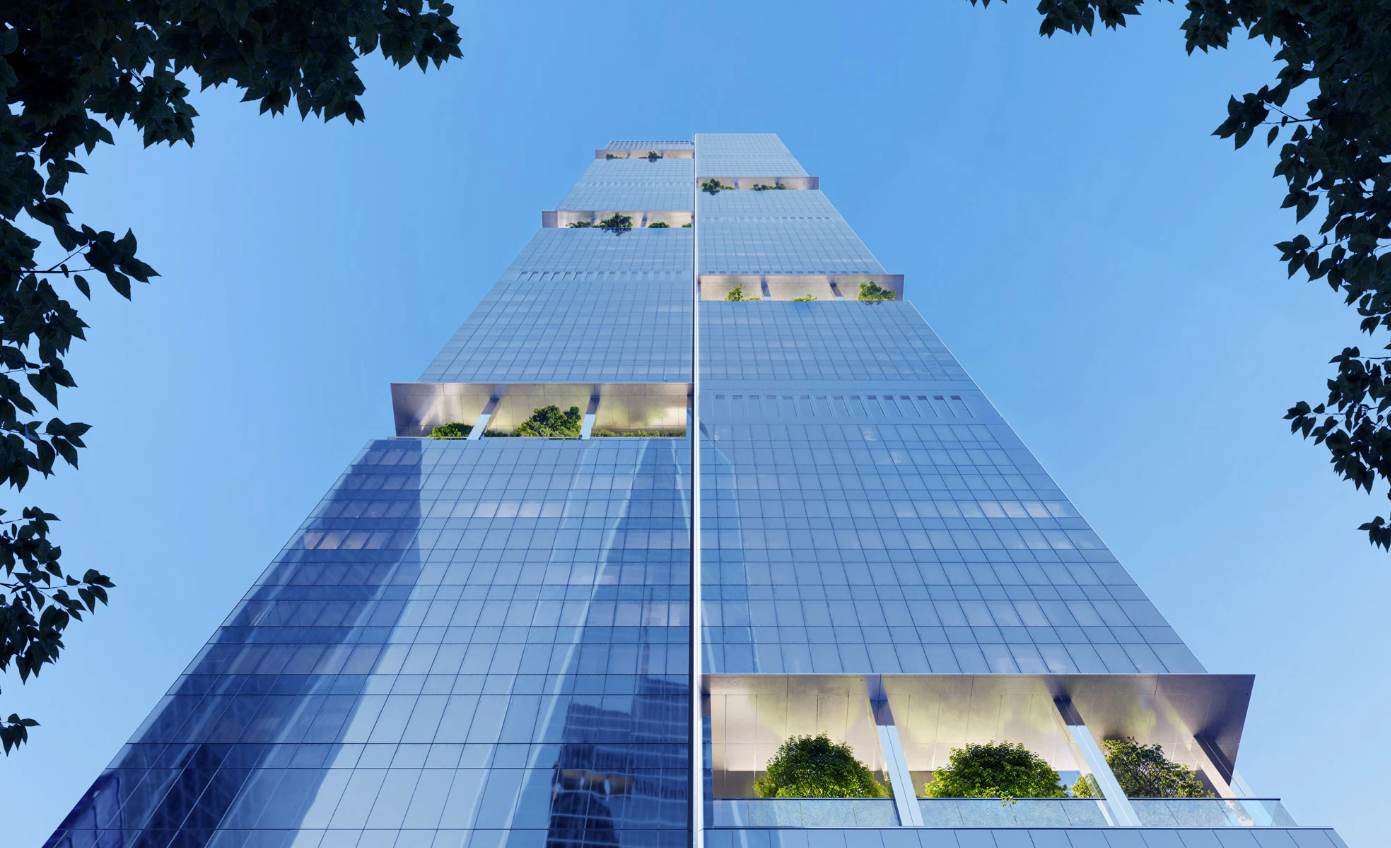
Renderings show a sleek glass tower featuring several landscaped terraces and corner gardens integrated into the upper levels of the building, reflecting a growing focus on sustainability and workplace amenities in modern office design.
The project has undergone several design revisions over the past decade. Earlier concepts included a dramatically stepped tower designed by Bjarke Ingels Group before the project ultimately returned to Foster + Partners’ design approach.
Anchor Tenant Enables Construction
For years, the biggest challenge facing the project was securing a major tenant willing to anchor the building.
Large office towers typically require a significant pre-lease commitment before construction financing can be secured. American Express’s decision to occupy the building provides that commitment and effectively unlocks the project.
The company plans to relocate its headquarters from nearby Brookfield Place to the new tower once construction is complete.
Industry observers note that securing a global financial institution as the sole tenant significantly reduces leasing risk and makes financing the project far more feasible.
Construction Timeline and Development Scale
Construction is expected to begin as soon as spring 2026, with completion targeted for around 2031.
The project will deliver nearly 2 million square feet of office space, with capacity for thousands of employees.
In addition to office space, the building is expected to include:
- modern workplace amenities
- landscaped terraces and green spaces
- ground-floor retail
- connections to the surrounding transit infrastructure.
The tower will sit adjacent to the Oculus transit hub, which links multiple subway lines and PATH trains, reinforcing the World Trade Center site as one of the most connected business districts in the city.
Completing a Historic Redevelopment
The new tower represents the final phase of one of the most ambitious redevelopment projects in the United States.
Following the destruction of the original World Trade Center towers in 2001, Lower Manhattan underwent a massive reconstruction effort that included:
- One World Trade Center
- 3 World Trade Center
- 4 World Trade Center
- the National September 11 Memorial & Museum
- the Oculus transportation hub.
The construction of 2 World Trade Center will complete the commercial office component of the site and mark the culmination of more than two decades of redevelopment.
A Signal of Confidence in New York’s Office Market
The decision by American Express to build a new headquarters tower comes at a time when office markets across the country continue to grapple with remote work and shifting workplace patterns.
Yet the commitment also signals continued confidence in high-quality office space in prime locations.
Newer buildings with modern amenities, strong transit access, and flexible work environments continue to attract major corporate tenants even as older office buildings struggle with vacancy.
For Lower Manhattan, the project reinforces the district’s role as a major global financial and business hub.
Final Thoughts
The launch of construction at 2 World Trade Center marks an important milestone not only for the World Trade Center site but for the broader redevelopment of Lower Manhattan.
More than two decades after the original towers were destroyed, the final office tower is finally poised to rise — bringing with it a new global headquarters, thousands of jobs, and the completion of one of the most significant urban redevelopment projects in modern American history.
Subscribe to Real Observer
Stay ahead of the market. Real Observer covers New York Tri-state development, capital markets, and real estate intelligence every weekday. Subscribe free →